
Systems Design Meditation · Edition 1
The Agent Is Not the System
Why AI Is Becoming an Infrastructure Problem

Edward Calderón
Software Architect
AI is starting to disappear into infrastructure.
Not because it matters less. Because it is moving deeper into the stack.
For several years the public conversation focused on the model. Which model reasons better? Which model has the larger context? Which model writes better code? Those questions remain useful. But they are no longer sufficient.
A model answers. An agent can act. Once the system can act, architecture becomes as important as intelligence.
The unit of analysis has changed
A language model maps an input to a probabilistic output. An operational agent surrounds that model with memory, tools, identity, policies, queues, databases and feedback. It may read a ticket, query production telemetry, alter a configuration and notify a customer. Each step crosses a trust boundary. The quality of the generated sentence is only one small part of the result.
This is why the model is not the system. The model is one participant inside the system.
The useful questions now look familiar to anyone who has operated cloud or distributed infrastructure: What can the agent access? Who delegated its authority? What can it modify? What state does it maintain? How is the action observed? What happens if it is wrong? Can the action be reversed? Who is accountable?
Tool access converts a reasoning error into a possible state transition. If a chatbot invents a refund policy, the output is wrong. If an agent executes the refund, updates the ledger and closes the case, the surrounding organization has changed. The failure model is no longer confined to text.
Design for bounded action
Reliable agent infrastructure needs several boundaries. Identity should be workload-specific rather than a shared API key. Authorization should be narrow, short-lived and explicit about the resources and actions allowed. High-impact operations need approval gates. Every tool invocation needs structured audit data: actor, delegator, input, policy decision, output and resulting state.
Observability also has to move above ordinary request tracing. A trace can tell us that a call succeeded while the business action was incorrect. We need to connect model decisions to tool calls and tool calls to durable effects. The relevant measure is not only latency or token use. It is whether the intended invariant still holds.
Rollback is equally concrete. Some actions can be compensated: a deployment can return to an earlier revision. Others cannot truly be reversed: an email was sent, a secret was exposed, a payment settled. Architecture should classify actions before an agent receives them, not after an incident.
Consider an agent assisting with infrastructure changes. It can safely inspect metrics and propose a patch. Applying that patch to a sandbox may require a scoped credential. Production needs policy evaluation, a human approval for risky changes, progressive rollout, health checks and an automatic stop condition. The agent can participate throughout without becoming an unbounded administrator.
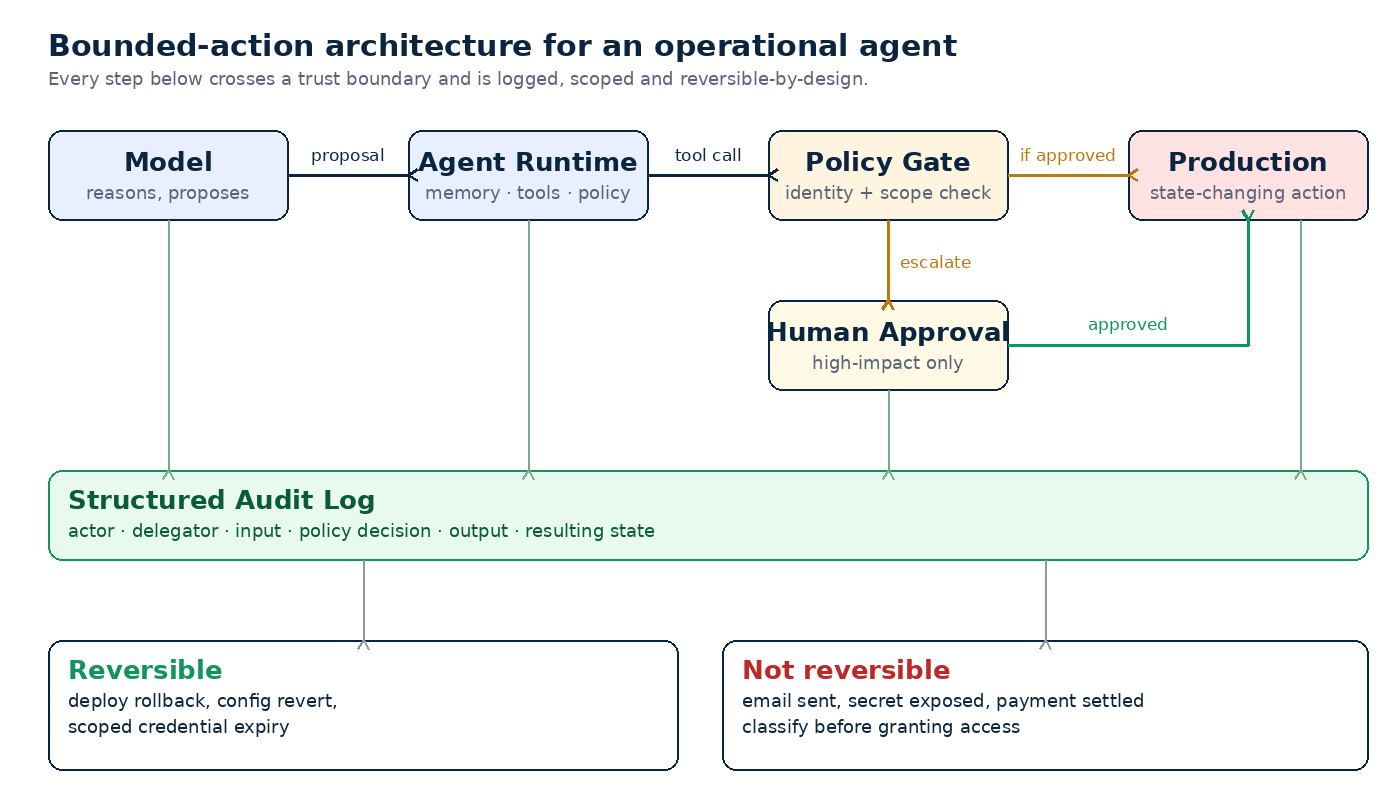
This pattern resembles mature DevSecOps because the underlying problem is familiar: moving change through a system without losing control of risk. Agents make the interface more flexible, but flexibility does not remove operational discipline.
Capability is not reliability
A very capable model inside poorly designed infrastructure produces a fragile product. A slightly less capable model inside excellent architecture may produce a much more reliable system. The second system can constrain uncertainty, detect failure and recover.
This is also why enterprise adoption will be uneven. Demonstrations optimize for visible capability. Production systems must handle identity lifecycle, data boundaries, incident response, cost controls, regulatory evidence and degraded dependencies. These layers are not peripheral plumbing. They determine whether intelligence can be trusted with work.
The emerging agent standards are useful, but no protocol substitutes for architecture. An agent framework cannot decide an organization's risk tolerance. A model provider cannot define which state transitions are reversible. Those decisions belong to the system around the model.
The practical direction is therefore not autonomy everywhere. It is graduated autonomy: observe, recommend, act within a narrow boundary, earn broader authority through measured reliability. This gives teams a way to learn without pretending probabilistic components are deterministic.
Intelligence alone does not create reliable infrastructure.
Architecture does.